
ENERGY · No. 10soon
How a Nuclear Power Plant Works
12 minOpens after Power grid
Open a nuclear power plant and see how splitting atoms boils water to make electricity.
Hands-on lessons for curious adults
Short, playful lessons on how things work: cut a flashlight open, make a heart beat, drill into the Earth, fly a rocket to orbit. The drawing answers like the real thing. In your browser, on any phone.
Free at launch · English · made for phones
How a lesson goes
Look inside, do something to it, guess, then build it back. The moves below are pieces of real lessons, and the plan ticks itself off as you go.
Cut and look
Draw across the case: it opens where you stop. Then tap the dots.
Drag
Push it all the way and watch every pin line up.
Zoom
Drag the loupe down, step by step, until one atom fills the lens.
Predict, then check
Pick an answer, then swing the engine's bell and watch the rocket lean over.
Build
Stick the four parts from under the engine back on, then crank it to start it.
Lesson decks
50 lessons in six branches: 10 ready to play, the rest being drawn. Finish a lesson and its card is yours. Pick a branch to deal its deck, then point at the edge of a card, or tap it, to pull it out.
Opens after Power grid
Open a nuclear power plant and see how splitting atoms boils water to make electricity.
Opens after Power grid
Climb inside a wind turbine and see how the wind's push becomes electricity.
Opens after Motor + Battery
Lift the floor of an electric car and follow the power from the battery to the wheels.
Opens after Battery
Shine light on a solar cell and see how it pushes electrons round a circuit.
Opens after Motor
Follow electricity from the power station, along the lines, down to your plug.
Opens after Motor
Follow the refrigerant round a fridge and see how it carries heat from inside to out.
Opens after Circuit
Open a lithium-ion cell and follow the ions as it charges and runs down.
Opens after Circuit
Saw a toy motor open, push a wire with a magnet, and find out why a motor keeps spinning instead of getting stuck.
Opens after Flashlight
Wire a battery to a bulb, see why one wire isn't enough, and build a working circuit yourself.
Open from the start
Open up a classic flashlight, close the loop, and rebuild it yourself to see why a tiny switch makes light.
The home screen
A map of every lesson, and tabs for everything you've collected so far.
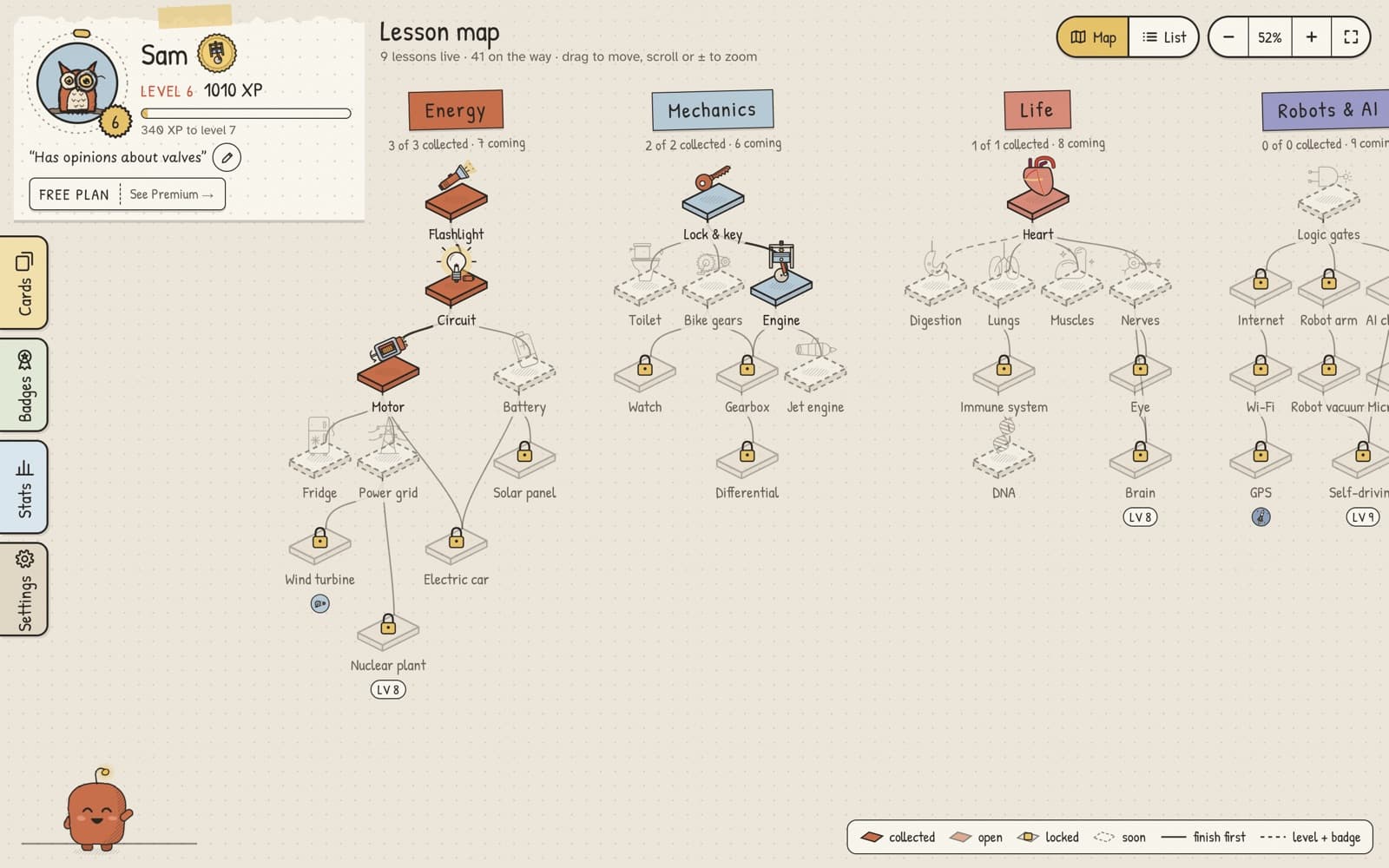
Six branches, each a family tree of lessons. Finish one and the next ones open.
The look
We call the style Field Notes: ink on warm paper, coloured in afterwards. Simple enough to read on a phone, true to the real thing: proportions and the order of the parts stay as they are. Point at a tile, or tap it, to see how it's done.
Every outline is redrawn twelve times a second with a slight wobble, a trick from hand-drawn animation. The drawing feels alive even when nothing in it moves.
Shade is drawn the way a pen would draw it: fine ink lines at 45°, about four pixels apart. No grey gradients and no darker paint, so the colours stay clean on any screen.
Tap a part and a thin leader line draws itself out of it, with the part’s name written at the end in capitals. No legend to look up, no numbers to match.
Drag across a machine and its case opens along your line, like paper under scissors. Stop anywhere: the cut stays open, so you can look inside for as long as you like.
Each step is a torn sheet of dot-grid paper, taped down. The lesson plan is a handwritten list: what you’ve done gets a wavy line through it and a tick.
In a challenge the parts come back as die-cut stickers on a tray. Drag each one to its dashed spot, then test what you built. Finish a lesson, and its badge goes up in your trophy hall.
Energy is clay, Mechanics sky blue, Life rose, Robots & AI lavender, Earth & Space dusk blue and Matter sage. Wheat yellow is kept for whatever flows: current, heat and light.
Pip learns next to you: asks the question before a step, points at what to look at, frowns when a part is in the wrong place and cheers when it works. Six moods, no lectures.
The sticker book
Finish a lesson and its sticker goes up in your trophy hall. There are 50 to collect, one for every lesson on the map, each drawn by hand like everything here. Point at one to see which lesson it's from.
The waitlist
Leave your email and we'll write when the first lessons open. Tell us what to take apart first, and we'll put it near the top of the list.
Join, and this card is yours.
First in line when the lessons open.
Questions
Curious grown-ups who want to know how things really work: the engine in a car, the lock on the door, the planet under your feet. No school, no exams, no maths you didn't ask for.
The first lessons will be free. Later there may be a paid plan for the whole library, and you'll be able to cancel it in one click.
We're drawing the first lessons now. Join the waitlist and you'll be the first to hear.
Before a lesson is published, every fact in it is checked against a source we've read ourselves, and the drawings keep the real proportions. Where a lesson has to simplify, it says so.
Yes. Every lesson is made for a phone first: you cut, drag, turn and tap with your thumb.


